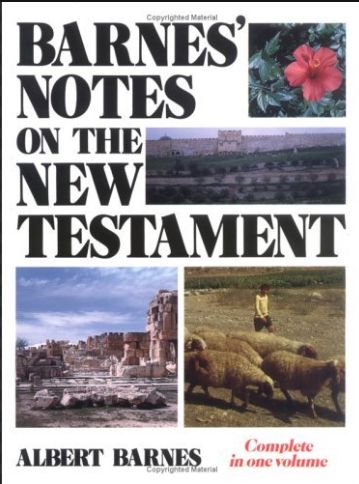
Barnes’ New Testament Notes

Barnes New Testament Notes
Albert Barnes (1798-1870) was an American theologian, born at Rome, New York, on December 1, 1798. He graduated from Hamilton College, Clinton, New York, in 1820, and from Princeton Theological Seminary in 1823. Barnes was ordained as a Presbyterian minister by the presbytery of Elizabethtown, New Jersey, in 1825, and was the pastor successively of the Presbyterian Church in Morristown, New Jersey (1825-1830), and of the First Presbyterian Church of Philadelphia (1830-1867).
He held a prominent place in the New School branch of the Presbyterians during the Old School-New School Controversy, to which he adhered on the division of the denomination in 1837; he had been tried (but not convicted) for heresy in 1836, the charge being particularly against the views expressed by him in Notes on Romans (1835) of the imputation of the sin of Adam, original sin and the atonement; the bitterness stirred up by this trial contributed towards widening the breach between the conservative and the progressive elements in the church. He was an eloquent preacher, but his reputation rests chiefly on his expository works, which are said to have had a larger circulation both in Europe and America than any others of their class.
Of the well-known Notes on the New Testament, it is said that more than a million volumes had been issued by 1870. The Notes on Job, the Psalms, Isaiah and Daniel found scarcely less acceptance. Displaying no original critical power, their chief merit lies in the fact that they bring in a popular (but not always accurate) form the results of the criticism of others within the reach of general readers. Barnes was the author of several other works of a practical and devotional kind, including Scriptural Views of Slavery (1846) and The Way of Salvation (1863). A collection of his Theological Works was published in Philadelphia in 1875.
In his famous 1852 oratory, “What to the Slave is the Fourth of July?”, Frederick Douglass quoted Barnes as saying: “There is no power out of the church that could sustain slavery an hour, if it were not sustained in it.”
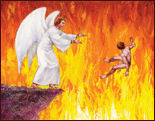 How can a loving God send people to hell? explains how God's love interacts with God's judgment and wrath. Love has to involve two people, and when somebody does not respond correctly to God's love, God is despised and spurned, therefore it is logical that God excludes that person from all the God has to offer.
(https://www.theologicalsystems.com/god/how-can-a-loving-god-send-people-to-hell/)
How can a loving God send people to hell? explains how God's love interacts with God's judgment and wrath. Love has to involve two people, and when somebody does not respond correctly to God's love, God is despised and spurned, therefore it is logical that God excludes that person from all the God has to offer.
(https://www.theologicalsystems.com/god/how-can-a-loving-god-send-people-to-hell/)
Barnes died in Philadelphia on December 24, 1870.-bio
Download
barnes-new-testament-notestw.cmt.twm (8909 downloads )More Modules on New Testament
- ironside-addresses-on-second-corinthians-twv6-twid.gbk.twm
- ironside-addresses-on-the-first-epistle-to-the-corinthians-twv6-twid.gbk.twm
- Ironside, Harry A. – Ephesians
- Ironside, Harry A. – Expository Notes On The Epistles Of James And Peter
- Ironside, Harry A. – Lectures on the Book of Revelation
- Ironside, Harry A. – Lectures on the Epistle to the Romans
- James S. Candish – Ephesians
- John Gill Exposition of the Entire Bible (Baptist)
- Jon Courson’s Application Commentary (New Testament)
- Jones Mark a Devotional Commentary
- Jowett Epistles of First and Second Peter
- Jowett, J.H. Epistles of Peter
- Kakoulide Epistles of John
- Kakoulide James
- Kakoulide Jude
- Keathley III Colossians
- Keathley Titus
- Keathley-Walvoord Commentary on Revelation.cmt.twm
- Kelly Epistle to the Hebrews
- King, Guy H. – 1John – The Fellowship
- King, Guy H. – 2 Timothy – To My Son
- King, Guy H. – Colossians – Crossing The Border
- King, Guy H. – Philippians – Joy Way
- Koenig- Revelation of Jesus Christ Through the Ages
- Krell Philippians Take a Joy Ride
Advertisement
In this explanation, you can set theWord to show Greek or Hebrew text of verses when you pass the mouse over verse references.