Schaff A Popular Commentary on the New Testament 1.1

Schaff A Popular Commentary on the New Testament 1.1
taken from Wordmodules.com
Philip Schaff is best known for being the editor of Lange’s Commentary and the History of the Christian Church.

Covetousness is Idolatry an article explaining from the Bible viewpoint how covetousness is a religion unto itself, worshiping money instead of the true God of the Bible. This foundational understanding helps believers to identify the false prophet and reject and flee from their deceptive ministries.
theologicalsystems.com/false-prophet-teacher/covetousness-is-idolatry/
In the introduction, Schaff describes this commentary as Evangelical, interdenominational, and explanatory. Comparing Lange’s Commentary with this one, Schaff notes that Lange’s Commentary was written for scholars and academics, while this commentary was written for laymen.
Familiar and trustworthy authors like Marcus Dods, William B. Pope, Edward H. Plumptre, and Philip Schaff wrote this commentary (see below for the complete list of contributors). Built around solid exegesis with practical application, nearly every verse in the New Testament has a comment. Knowledge of Greek and Hebrew is not needed for this commentary. A few books, like Acts, delve into the Greek but enough is explained so the average reader can understand.
Because the commentary is interdenominational, Schaff strives to present differing arguments fairly and clearly, such as eschatology: preterism and premillennial.
Schaff also focuses on clearly and succinctly making his points. For example, a note in Hebrews says:
“In this last dispensation God is said to speak to us in His Son. The Son is the medium of the revelation. As revealer He has as His associates, the apostles. But this office of Christ is quite subordinate. His true character is that He is Himself the revelation. To know God and His Son Jesus Christ is eternal life. God in Christ, Christ as God,—redeeming, renewing, sanctifying,—is the saving doctrine of the Gospel.”
Schaff embraces the Authorized Version. He is not afraid to critique the translation, sometimes offering his “better” substitutes and providing depth where the A.V. is inadequate. He also occasionally mentions the Revised Version, targums, and other manuscripts. (Note: Schaff served on the committee that produced the American Standard Version.)
In the preface, Schaff says, the Bible is of “divine origin and character…It is now more extensively studied than ever before…It is inexhaustible. It never grows old, but increases in interest and value as time flows on. Human books have their day, but ‘the Word of the Lord endureth forever.’” — If only Schaff could have seen the Internet to know how true his words have become!
theWord Edition
The preface and introduction to this commentary are shown in the Matthew Book Comments. The introductions to the first three gospels (presented together) are also in the Matthew Book comments.
To save space in the printed edition, some portions of this commentary avoided extra lines by substituting the long dash (—) for a new paragraph. This resulted in very long actual paragraphs. In many cases (where appropriate) the long dash was turned into a new paragraph for readability. Because so many writers contributed to this commentary, there was a divergence of styles and formatting. I have attempted to standardize this as much as possible.
Schaff A Popular Commentary on the New Testament 1.1
Download
schaff-p-a-popular-commentary-ntwm.cmt.twm (1298 downloads )More from this Category
- schaff A Popular Commentary on the New Testament
- Schaff A Popular Commentary on the New Testament 1.1
- Seiss Apocalypse
- Seiss, Joseph – Apocalypse
- Simpson – Commentary on James
- Simpson Christ in the Bible Philippians
- Simpson Commentary on 1 & 2 Thessalonians
- Simpson, A.B. – Christ in the Bible Colossians Commentary Colossians
- Smith, James – Believer’s Triumph!
- Smith, James-Handfuls on Purpose
- Spurgeon – Matthew Commentary
- Spurgeon Sermon Commentary from Acts thru Revelation
- Spurgeon Sermons from Philemon
- Spurgeon, Charles – Sermon Commentary from the Gospels
- Stam Acts Dispensationally Considered
- Stedman 1 & 2 Thessalonians
- Stedman Commentaries.cmt.twm
- stedman-expository-studies-in-corinthians-vol-1-twv6-twid.twm
- Steele Notes on the Apocalpyse
- Stevens-Parables of the New Testament
- Stott Bible Speaks Today NT Commentary.cmt.twm
- Summarized Bible Commentary 1.2
- Swift Salvation in the Book of Philippians
- Talbot Addresses on Romans
- Talbot Lectures on Ephesians
AdvertisementtheWord Tutorial Website
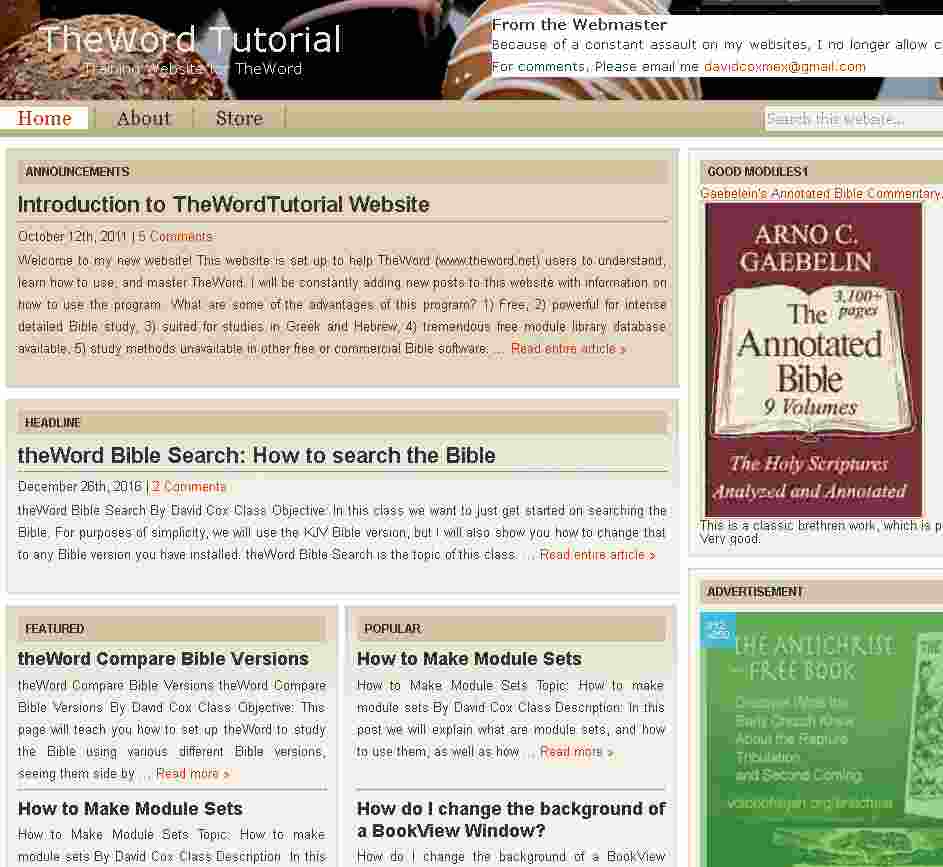 Visit our learning theWord website for help classes on how to use theWord and do various things within the program. We also have tips, and module creation helps.